Chalk, Markers, and the Science of Memory: Why the Humble Blackboard Still Belongs in Every Modern Classroom
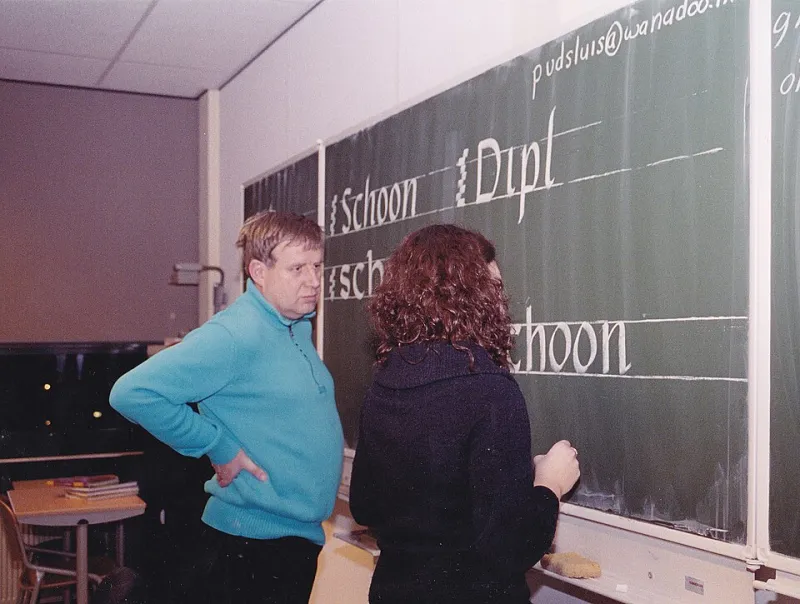
Photo: Peter van der Sluijs, CC BY-SA 3.0, via Wikimedia Commons
Walk into almost any American school district today and you will encounter classrooms equipped with smartboards, document cameras, and projection systems capable of displaying high-definition content within seconds. The assumption, broadly held across many administrative circles, is that more technology inevitably produces better outcomes. Yet a growing body of cognitive science research challenges that assumption — not by dismissing digital tools, but by revealing the remarkable, often underappreciated advantages of analog instruction methods that have served educators for well over a century.
At The Blackboard, we believe great teaching begins with understanding how learning actually works. That means examining the evidence honestly, even when it complicates the prevailing narrative.
The Pace Problem: Why Slower Can Mean Deeper
One of the most significant advantages of a traditional blackboard or whiteboard is perhaps the most counterintuitive: it forces teachers to slow down.
When an instructor writes content by hand, the pace of delivery is naturally moderated. Students receive information incrementally, in real time, rather than being confronted with a fully populated slide that competes for their attention all at once. Dr. Kenneth Kiewra, an educational psychologist at the University of Nebraska–Lincoln who has spent decades studying note-taking and information processing, has noted in his research that students who receive information in a paced, sequential format tend to encode that material more deeply than those who process it in large, simultaneous chunks.
"Cognitive load theory is not abstract," explains one veteran high school chemistry teacher from suburban Ohio who has taught for twenty-two years. "When I write a chemical equation step by step on the board, my students are building that equation in their heads alongside me. When I click to a pre-made slide, I can see their eyes glaze. They're reading, but they're not thinking."
This observation aligns with what researchers call the "redundancy effect," a well-documented phenomenon in which presenting identical information through multiple simultaneous channels — such as a teacher speaking while students read the same words on a projected slide — can actually impair comprehension rather than reinforce it.
The Neuroscience of Handwriting and Visual Construction
The cognitive benefits of handwriting have received substantial attention in recent years, particularly in debates about whether students should learn cursive. But the implications extend beyond the student's desk to the front of the classroom.
Research published in journals including Psychological Science and Educational Psychology Review has consistently demonstrated that information presented in a handwritten or hand-drawn format engages different neural pathways than printed or digitally rendered text. When a teacher constructs a diagram, equation, or concept map by hand on a board, students are not merely observing a static image — they are witnessing a process of construction that mirrors the cognitive work they themselves must perform to understand the material.
Dr. Virginia Berninger, a professor emerita at the University of Washington whose work focused on written language and the brain, described handwriting as a "self-teaching" mechanism. When students observe handwriting in real time, their brains engage motor memory systems associated with their own writing experiences, creating an additional layer of cognitive engagement that a projected image simply cannot replicate.
This phenomenon has practical implications for subjects ranging from mathematics to literary analysis. A geometry teacher who draws a triangle and constructs its altitude by hand invites students into the spatial reasoning process. A literature teacher who writes a thesis statement on the board, then revises it aloud and in real time, models the very thinking process that students need to internalize.
What Veteran Educators Have Long Understood
Across the United States, experienced teachers have often maintained their blackboards and whiteboards not out of nostalgia, but out of practical wisdom accumulated over years of classroom observation.
A middle school science teacher in Portland, Oregon, who asked not to be identified by name, described a telling experiment she conducted informally over two consecutive school years. During the first year, she delivered her unit on ecosystems almost entirely through digital presentations. During the second year, she introduced the same content using a combination of whiteboard diagrams and handwritten vocabulary lists before transitioning to digital materials. Her assessment data — while not a controlled study — showed a meaningful improvement in quiz scores and a marked increase in student-generated questions during class discussion.
"I think the board gave them something to anchor to," she reflected. "They watched me build the food web from scratch. It wasn't just an image they'd seen. It was something we'd made together."
This sense of shared construction is difficult to replicate with a pre-designed digital presentation, no matter how visually polished. The blackboard, by its very nature, is a collaborative surface — a space where thinking happens publicly, imperfectly, and in real time.
The Strategic Integration Model: Neither/Nor Is the Wrong Question
It is worth stating plainly that this discussion is not an argument for abandoning digital tools. Smartboards, interactive displays, and educational software platforms offer genuine advantages — particularly for visual simulations, data visualization, and accommodating diverse learning needs. The question facing teachers is not whether to use technology, but when analog methods serve students better.
Educational researchers at Stanford's Graduate School of Education have advocated for what some call a "strategic integration" model, in which teachers make deliberate, research-informed decisions about which medium best serves a given instructional goal at a given moment. Under this framework, a teacher might introduce a new concept through handwritten board work to establish comprehension, then reinforce it with a digital simulation, and finally assess understanding through a written exercise.
Practical strategies for implementing this approach include the following:
Use the board for concept introduction. Whenever presenting a genuinely new idea, write it out by hand before displaying any digital content. Allow students to watch the concept take shape.
Reserve digital tools for reinforcement and enrichment. Video clips, interactive graphs, and multimedia resources are most effective after foundational understanding has been established, not before.
Leverage the erasable surface for revision. One of the blackboard's most powerful features is its impermanence. Crossing out, revising, and rebuilding content in front of students models intellectual flexibility and critical thinking.
Involve students at the board. Having students write, diagram, or solve problems at the board activates kinesthetic learning and creates accountability in ways that clicking through a presentation does not.
Reclaiming the Front of the Room
The blackboard — whether literal chalk-on-slate or a modern dry-erase surface — is more than a teaching tool. It is a symbol of the teacher's active presence in the instructional moment. It communicates, visually and physically, that learning is a process of construction rather than consumption.
In an era when students spend increasing hours passively absorbing content through screens, the classroom that invites them to watch ideas being built — and to participate in that building — offers something increasingly rare and increasingly valuable.
The research is clear, the practitioner experience is consistent, and the cognitive science is compelling. The blackboard is not a relic. It is, in many respects, precisely the kind of teaching tool a modern classroom most needs.
Great teaching has always begun with meeting students where their minds are. Sometimes, the most powerful place to do that is at the front of the room, marker in hand, building something together.