The Cognitive Case for Doing Nothing: Why Empty Classroom Moments Are Full of Learning
Photo: Mennonite Church USA Archives, No restrictions, via Wikimedia Commons
There is a particular kind of discomfort that settles over a classroom when nothing is happening. The teacher shifts weight from one foot to the other. A student glances up from a blank page, waiting for a prompt. Someone coughs. The silence feels wasteful — a gap in the lesson plan that should have been filled.
But what if that discomfort is worth sitting with? What if the blank moment is not a failure of planning, but a feature of it?
Across decades of cognitive research and classroom observation, one finding keeps surfacing: students need unstructured mental space to process, consolidate, and ultimately own what they are learning. The challenge for educators is learning to trust that space — and to design for it deliberately, rather than treating it as something to be apologized for.
What the Brain Does When You Stop Talking
The human brain does not function like a recording device. Information does not simply enter through the ears and lodge itself permanently in long-term memory. Instead, learning is a biological process that requires time and cognitive effort to complete.
When students encounter new material, the hippocampus — the brain's primary hub for memory formation — begins encoding that information. But encoding is not instantaneous. Research in cognitive neuroscience consistently shows that consolidation, the process by which short-term memories become durable long-term ones, happens most effectively during periods of low external stimulation. In other words, the brain needs quiet to do its deepest work.
This is not merely theoretical. Studies examining the "default mode network" — a set of brain regions that activate during rest and mind-wandering — have found that this network plays a critical role in creative problem-solving, self-reflection, and the integration of new concepts with prior knowledge. When teachers move immediately from one activity to the next without pause, they may inadvertently interrupt this consolidation process before it has a chance to begin.
The Instructional Minute Fallacy
One of the most persistent pressures in American classrooms is the imperative to account for every instructional minute. With state standards to cover, benchmark assessments on the horizon, and administrators occasionally walking through with clipboards, silence can feel professionally risky.
This pressure is understandable, but it rests on a flawed premise: that instruction only occurs when the teacher is actively delivering content. In reality, some of the most significant learning happens in the spaces between delivery — when a student stares at a half-finished equation, when a reader pauses mid-paragraph to sit with a complicated idea, or when a class falls quiet after a particularly challenging discussion question.
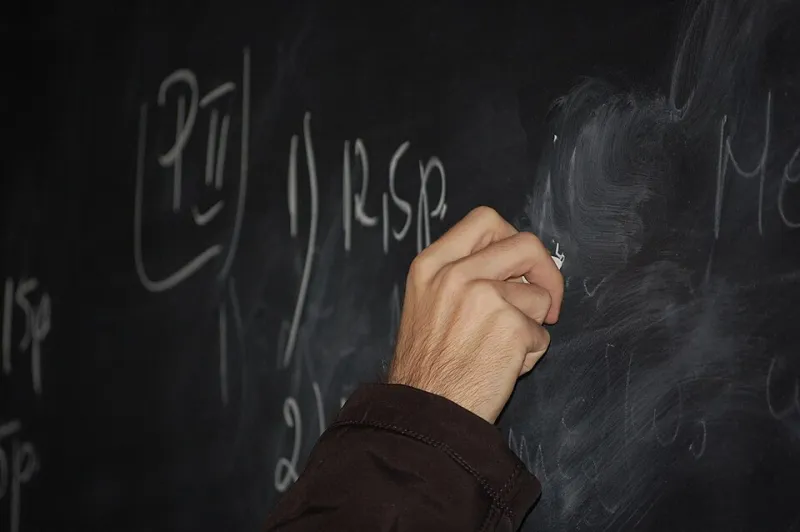
Think of it this way. A blackboard covered edge to edge with notes, diagrams, and equations may look impressively full. But if a student cannot identify where one idea ends and another begins, the density becomes noise. The margins — the empty spaces — are what give the content its shape. Unstructured thinking time works the same way in a lesson. It is the white space that makes the writing legible.
Practical Approaches to Building Thinking Time In
Integrating deliberate pauses into instruction does not require abandoning lesson structure. It requires reframing what structure is for.
The Extended Wait Time Protocol
Research by education scholar Mary Budd Rowe in the 1970s — findings that have since been replicated many times over — demonstrated that extending wait time after posing a question from the typical one or two seconds to three to five seconds dramatically improves the quality and frequency of student responses. Students give longer answers, more students participate, and the depth of reasoning increases. This is not a small effect. It is a structural shift in who gets to think in your classroom.
Practice waiting longer than feels comfortable. Count silently to five before calling on anyone. Resist the urge to rephrase the question or offer a hint. The discomfort you feel in those seconds is the sound of thinking happening.
Reflection Pauses After New Content
After introducing a new concept, build in two to three minutes of silent individual reflection before moving to discussion or practice. Ask students to write whatever comes to mind — questions, connections, confusions, half-formed thoughts. This is not a graded activity. It is a cognitive clearing exercise, a way of helping students find out what they actually think before being asked to perform that thinking publicly.
The Open Prompt
Occasionally, resist the temptation to provide a specific prompt at all. Ask students to spend five minutes writing about "what's sitting with you from today's lesson" or "something from this unit you keep returning to." The openness is the point. When students must decide what matters to them — rather than responding to a teacher's predetermined question — they are exercising precisely the kind of independent cognition that structured prompts cannot always reach.
Scheduled Synthesis Days
Every two to three weeks, consider dedicating a portion of class time to what might be called a synthesis session: no new content, no structured activity, just time for students to revisit notes, make connections across units, and think without a destination. This can feel counterintuitive, especially under curricular pressure. But students who regularly engage in this kind of integrative thinking perform better on assessments that require transfer — the application of knowledge to novel situations.
Addressing the Objections
Teachers who experiment with unstructured thinking time often encounter two concerns: that students will disengage, and that the time cannot be justified to observers or administrators.
On disengagement: students who appear to be staring into the middle distance during a thinking pause are not necessarily off-task. For many learners, especially those who process information more slowly or who come from environments where quiet reflection is rare, this time is genuinely productive. The challenge is teaching students to use it. Begin by naming what you are doing and why. "I am giving you three minutes to think without any output expected. Your only job is to let today's ideas settle." Over time, students internalize this practice and begin to value it.
On administrative justification: the research base for retrieval practice, spaced repetition, and metacognitive reflection — all of which are supported by unstructured thinking time — is robust and well-documented. If you need to articulate the instructional purpose of a quiet moment, you have the evidence to do so.
The Blank Canvas Is the Lesson
Great teaching has never been solely about transmission. It has always been about creating the conditions under which students can construct understanding for themselves. Unstructured thinking time is one of those conditions — perhaps one of the most underused.
The blank canvas in your classroom is not a problem to be solved. It is an invitation. When you learn to extend it, protect it, and trust it, you give your students something that no amount of content delivery can provide: the space to become thinkers on their own terms.