Are You Teaching the Board or Teaching the Room? A Practical Audit for Blackboard-Based Instruction
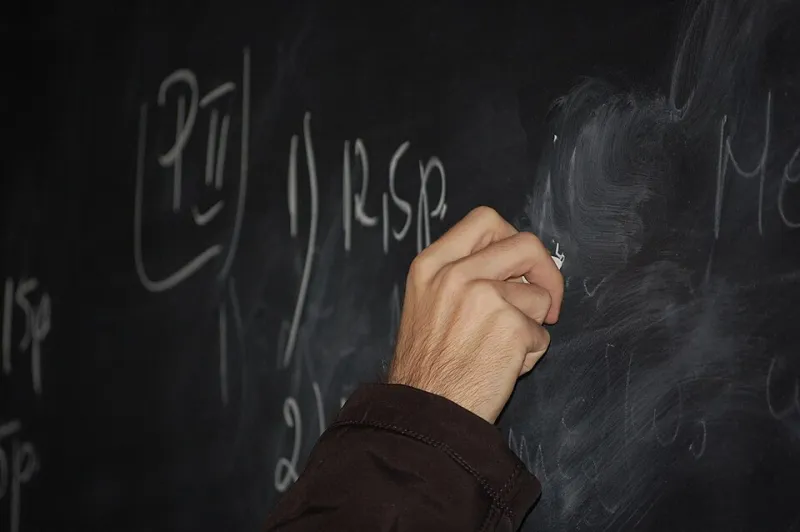
Photo: user:Alegri, Romania, CC BY 3.0, via Wikimedia Commons
There is a version of blackboard instruction that looks like teaching but functions more like narration. The teacher faces the board, writes steadily, speaks to the chalk or marker in hand, and fills the surface with content that students dutifully attempt to copy. The room is quiet. The board is full. And by the end of the period, a significant portion of the class has retained very little.
This is not a hypothetical scenario. It is, by most accounts, one of the most common and least examined patterns in American classrooms. The blackboard — a tool with genuine instructional power — becomes a liability when the teacher's relationship to it is more habitual than intentional.
This article is not a celebration of the blackboard's virtues. That ground has been covered. This is a diagnostic. It is an invitation to look honestly at what you are actually doing when you stand at the front of the room with a piece of chalk or a dry-erase marker, and to ask whether your students are learning from the board or simply watching it fill up.
The Difference Between Active and Passive Board Use
Passive board use treats the writing surface as a transcript. The teacher writes what they are saying, or writes ahead of what they are saying, and students receive the content as a parallel stream — one auditory, one visual — that they are expected to synthesize on their own.
Active board use treats the board as a thinking tool. Content appears strategically, in response to student responses, emerging questions, or instructional sequences that require visible scaffolding. The board does not simply record the lesson; it participates in constructing it.
The distinction matters because of how working memory functions. When students are simultaneously listening to a teacher speak, watching new content appear on the board, and attempting to take notes, they are managing three competing cognitive demands. Research on cognitive load theory — developed by educational psychologist John Sweller — consistently shows that exceeding working memory capacity degrades comprehension and retention. Passive board use almost always generates unnecessary cognitive load. Active board use reduces it.
Common Diagnostic Mistakes: A Checklist
Before introducing corrective strategies, it helps to identify which specific errors are at play. The following patterns represent the most frequently observed problems in blackboard-based instruction. Read each one and consider, honestly, whether it describes your current practice.
Writing while talking without pausing. This is the most pervasive problem. When a teacher speaks and writes simultaneously, students must decide in real time which channel to prioritize. Most will attempt both and succeed at neither. The fix is simple but requires conscious effort: pause speaking when writing, then pause writing when speaking. The brief silences that result are not dead air — they are processing time.
Handwriting that cannot be read from the back row. Legibility is not merely a courtesy; it is an equity issue. A student in the back third of the classroom who cannot read what is on the board is effectively excluded from the instructional record. Every teacher should periodically stand at the back of their own room and assess their written output honestly. Letter size, spacing, and contrast all matter. On a traditional blackboard, white chalk on a clean surface reads more clearly than colored chalk on a dusty one.
Information overload on a single surface. Some teachers fill the board from edge to edge over the course of a lesson, layering new content over old without erasing or organizing. By the midpoint of class, the board has become a wall of information with no clear hierarchy. Students cannot distinguish what is essential from what is supplementary, and the cognitive effort required to extract meaning from visual noise is significant. Treat the board as a living document: erase what has served its purpose, and use spatial organization — headers, columns, boxes — to signal relationships between ideas.
Facing the board during key explanations. This is a habit so ingrained in many teachers that they are unaware of it. When a teacher turns away from the class to speak toward the board, they lose visual contact with the room. They cannot see the student who has stopped writing, the raised hand at the side, or the look of confusion spreading across the third row. More practically, their voice projects away from the students who need to hear it. Develop the habit of stepping to the side of the board when explaining, so that your face and the written content are both visible simultaneously.
No visible organizational logic. Students learn to read a board the way they learn to read any document — by developing expectations about where information will appear and what its position signals. When content appears in random locations without consistent structure, that orientation fails. Consider establishing a predictable board layout: objectives in the upper left, vocabulary in a designated column, worked examples in the center. Consistency reduces the time students spend figuring out where to look.
The Self-Assessment: Recording and Reviewing Your Own Practice
The most reliable diagnostic tool available to any teacher is a recording of their own instruction. Set up a tablet or laptop at the back of the room and record a full class period of board-centered instruction. Then watch it with the following questions in mind:
- How often do I speak directly to the board rather than to the students?
- Are there moments when the board is full and I continue adding content without pausing?
- Can I read my own handwriting from the camera's position?
- Do students appear to be writing, watching, or neither during board segments?
- Is there a visible organizational logic to how content is arranged?
This kind of self-review is uncomfortable for most educators, and that discomfort is precisely why it is valuable. The gap between how we imagine our instruction and how it actually unfolds on video is often significant.
If recording feels too exposing, a trusted colleague can serve as an observer using the same checklist. Peer observation focused specifically on board mechanics — rather than broader instructional quality — tends to generate more actionable feedback and less defensiveness.
Rebuilding the Practice: Three Targeted Adjustments
Once you have identified the specific patterns that are undermining your board-based instruction, the path forward is not a wholesale reinvention of your practice. It is a series of targeted adjustments applied consistently over several weeks.
First, adopt the pause-write-pause-speak discipline. This single habit addresses the most common source of cognitive overload in board instruction. It requires no materials, no planning, and no additional time — only awareness and repetition.
Second, design your board layout before the lesson begins. Sketch a rough map of how the surface will be used during the period. Where will the central concept live? Where will student-generated responses go? Where will you work through examples? Pre-planning the board prevents the sprawling, unstructured accumulation of content that leaves students unable to identify what matters.
Third, build in comprehension checkpoints tied explicitly to the board. At regular intervals, stop writing and ask students a question that requires them to engage with what is currently displayed. This does not need to be elaborate — a simple "turn and tell your neighbor what this term means based on what we have written" serves the purpose. It confirms whether students are processing the content or merely copying it, and it gives you real-time diagnostic information before the lesson ends.
The blackboard is one of the oldest instructional technologies in American education. It endures because, used well, it makes thinking visible. The challenge is ensuring that the thinking it makes visible is yours and your students' — not just your handwriting moving across a surface while the room watches.