Competing With the Screen in Your Students' Pockets: How to Design a Classroom That Wins
There is a device in nearly every backpack in your classroom. It vibrates, glows, and delivers an unending stream of novelty calibrated by some of the most sophisticated engineers in the world to be as compelling as possible. And you, standing at the front of the room with a marker in hand, are expected to compete with it.
This is not a complaint about student behavior. It is a structural reality of contemporary K–12 education in the United States, and it demands a structural response. The question is no longer simply how to enforce phone policies — it is how to design a physical learning environment so cognitively engaging that students genuinely prefer to be present in it.
The blackboard, used strategically, is one of the most powerful tools a teacher possesses in that effort.
Understanding What You Are Actually Competing Against
Social media platforms and short-form video applications are not casually distracting. They are engineered to exploit the brain's reward pathways, delivering micro-doses of novelty, social validation, and visual stimulation in rapid succession. The result is a trained attentional habit — students have spent thousands of hours practicing the skill of scanning quickly and moving on when something fails to reward them immediately.
A static whiteboard covered in uniform black text offers nothing to interrupt that habit. It looks, to a conditioned eye, exactly like the kind of content worth skipping.
The solution is not to imitate the phone. Teachers who attempt to out-stimulate digital media with flashy presentations, rapid-fire transitions, or classroom "gamification" at every turn often find themselves exhausted and no more effective. The goal is not to replicate what the phone does — it is to offer something the phone fundamentally cannot: a shared, physical, evolving cognitive experience that unfolds in real time and demands active participation.
Visual Hierarchy as an Attentional Anchor
One of the most underused principles in classroom board design is visual hierarchy — the deliberate organization of information so that the eye knows, without being told, where to look first, second, and third.
Digital feeds present content in a flat, undifferentiated stream. Everything competes equally for attention, and the algorithm decides what rises. Your board should work on an entirely different logic: structured, intentional, and designed to guide cognition rather than simply present information.
Consider dividing your board into consistent spatial zones. A central panel might hold the primary concept or problem of the day. A left column might carry persistent vocabulary or reference material that accumulates across the week. A right margin might hold open questions — things not yet resolved, problems still in progress. This kind of zoning trains students to read the board the way a skilled reader reads a well-designed page: with purpose and direction.
When students know where to look and why, they look. That is the beginning of genuine attention.
Color and Movement as Deliberate Signals
Color on a blackboard is not decoration. Used with intention, it is a cognitive signal. Designating one color for definitions, another for examples, and a third for student-generated contributions creates a visual grammar that students learn to read over time. The brain processes color as a category marker, which means that a student glancing up from their desk can orient themselves instantly: that's blue, so it's a definition; that's red, so it's a student idea we're examining.
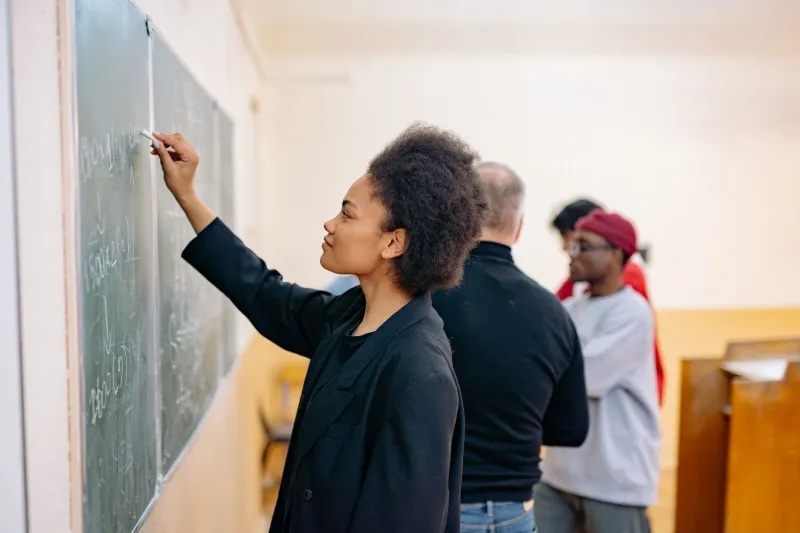
Movement matters equally. The act of a teacher physically writing something on the board — slowly, deliberately, in full view — is qualitatively different from the appearance of a pre-made slide. When you write, students watch the thought form. Their brains track the movement, anticipate the completion, and engage predictively with what is coming. That predictive engagement is attention. It is the opposite of passive scrolling.
This is why erasing and rewriting matters. When you cross something out and revise it publicly, you are modeling the kind of messy, iterative thinking that learning actually requires — and you are giving students a reason to keep watching, because the board is not finished. Neither is the thinking.
Designing for Cognitive Demand, Not Visual Comfort
There is a tendency to make classroom boards tidy and complete — to present information in its final, polished form. This impulse is understandable, but it is pedagogically counterproductive when the goal is sustained attention.
Boards that are too clean, too finished, and too static give students nothing to do. There is no question to hold, no gap to wonder about, no incomplete structure that the brain wants to resolve. The phone, by contrast, always has something new. The board wins not by being newer but by being unresolved — by presenting a problem, a partial map, a question with no answer yet written.
Leave blanks deliberately. Post a question in the upper corner at the start of class and do not answer it until the final ten minutes. Build a concept map that grows visibly as the lesson progresses, so that students can see the structure taking shape. These techniques create what cognitive scientists call "desirable difficulty" — a level of challenge that keeps the brain engaged rather than allowing it to drift toward the easier stimulation in a pocket.
The Board as a Social Contract
Perhaps the most underappreciated function of the physical board in an age of digital distraction is its social dimension. A phone is a private experience. The board is a shared one.
When a student's idea goes up on the board — written in their words, attributed to their thinking — something important happens. The classroom becomes a space where contributions are visible and valued in a way that no algorithm can replicate. Students who might otherwise disengage find a reason to stay present because the board is, in part, theirs.
Teachers who regularly invite students to write on the board, who record student questions alongside their own, and who treat the physical surface as a collaborative document rather than a lecture prop are doing something powerful: they are making the room itself more interesting than the phone.
That is not a small achievement. In the current attentional landscape, it may be one of the most important things a teacher can do.