The Living Archive: How to Turn Your Blackboard Into a Shared Memory System for Your Entire Class

Every experienced teacher has encountered the same moment: a student raises a hand to ask a question that was answered, clearly and thoroughly, two days ago. Another student cannot locate a definition that was discussed at length on Tuesday. A third has no recollection of the example that anchored last week's lesson.
This is not a failure of intelligence. It is a failure of memory architecture — and it is largely a structural problem that teachers can address through deliberate board practice.
The blackboard, in most classrooms, functions as a temporary display surface. Information appears, the lesson ends, and the board is erased. Each class period begins with a blank slate. This approach treats the board as a communication tool for the present moment — but it wastes an extraordinary opportunity to build something far more valuable: a shared external memory system that serves the entire class across days, weeks, and units of study.
Why External Memory Matters in Learning
Cognitive science has established for decades that human working memory is limited in both capacity and duration. Students can hold roughly four to seven pieces of information in active working memory at one time, and without deliberate encoding, much of what they encounter in a lesson fades within hours.
External memory systems — written notes, graphic organizers, reference charts — extend that capacity by offloading information to a stable physical medium. The brain, freed from the burden of retaining every detail, can devote more resources to higher-order thinking: analysis, connection-making, and application.
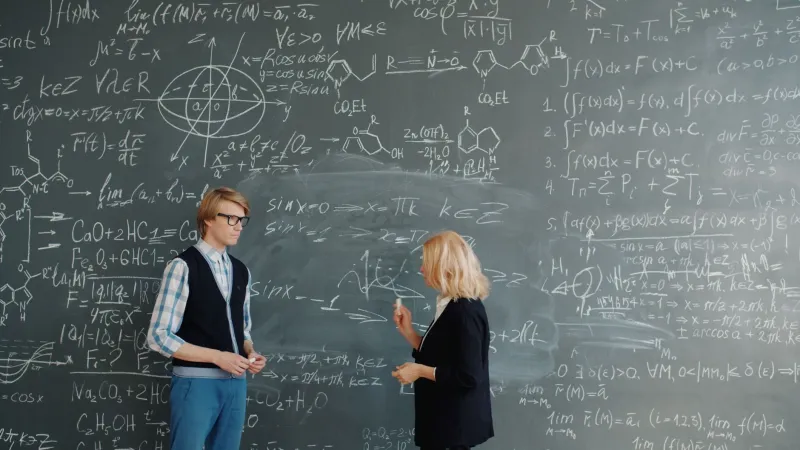
A well-maintained classroom board functions as the most visible and accessible external memory system in the room. Unlike a student's personal notebook, it is shared. Unlike a printed handout, it is dynamic. Unlike a digital slide deck, it is physically present and continuously available throughout every moment of instruction.
Building Persistent Visual Anchors
The first practical step toward a board-as-memory-system is rethinking what gets erased and when.
Not all board content is equal. Some content is transient: the work of a single problem, a brainstorm that served its purpose, a quick diagram drawn to illustrate a passing point. Other content is foundational: key vocabulary, core principles, essential questions, the conceptual framework of an entire unit. Transient content can and should be erased. Foundational content deserves to persist.
Many teachers find it useful to designate a specific section of the board — a corner panel, a side column, or even a small dedicated surface — as a permanent reference zone. This space holds the unit's essential vocabulary, the central question driving inquiry, or a running list of principles established through earlier lessons. Students learn quickly that this zone is stable, that it accumulates rather than resets, and that it represents the intellectual architecture of what they are studying.
When a student forgets a definition or loses the thread of an argument, pointing them to the reference zone is more pedagogically productive than simply re-explaining. It trains a habit of mind: look to the shared record before asking for a repetition.
Cumulative Problem Sets and Concept Maps
Beyond static reference zones, the board can host living documents that evolve with the class's understanding.
A cumulative concept map — one that begins on the first day of a unit with a single central term and grows outward as new ideas are introduced — gives students a visible record of how their knowledge is expanding. Each lesson adds connections. Each new concept is placed in relationship to what came before. By the end of a unit, students can look at the board and see the architecture of their own learning.
Similarly, a running problem set — a column of unsolved or partially solved problems that persists across multiple class periods — creates a sense of intellectual continuity. Students arrive knowing there is unfinished work on the board. They have a reason to orient themselves to the physical space before the lesson begins. The board is not blank; it is waiting.
This approach works particularly well in mathematics and science, where problem-solving is cumulative and where students benefit from seeing a chain of reasoning develop over time. But it is equally applicable in English and history classrooms, where central texts and arguments can be mapped and annotated as a unit progresses.
Training Students to Use the Board as a First Resource
Building a memory system on the board is only half the work. The other half is teaching students to use it.
Many students default to asking the teacher when they lose their place, forget a term, or need to re-orient themselves. This is understandable — the teacher is responsive, accessible, and forgiving. But it reinforces a dependency that does not serve students well beyond the classroom.
A deliberate shift in classroom culture can change this pattern. When a student asks a question that the board can answer, the teacher's most effective response is often a gesture rather than an explanation: a glance toward the reference zone, a pause that invites the student to look before asking. Over time, students internalize the message that the board is a resource, not just a backdrop.
This habit has metacognitive value far beyond the individual classroom. Students who learn to consult external reference systems — who develop the discipline of checking what is already recorded before seeking new input — are developing a transferable cognitive skill. They are learning to manage their own learning.
What the Board Holds That the Teacher Cannot
There is a final, often overlooked reason to invest in the board as a collective memory system: it holds the class's history in a way that no teacher explanation can replicate.
When a student sees their own words on the board — a contribution from three days ago that has been retained, referenced, and built upon — they experience something important. Their thinking has become part of the shared record. The class's intellectual life is visible, cumulative, and ongoing.
That experience of shared intellectual history is not a minor motivational bonus. It is one of the conditions under which students begin to think of themselves as members of a learning community rather than isolated recipients of instruction. The board, maintained with care and intention, can create exactly that condition — one mark, one day, one lesson at a time.