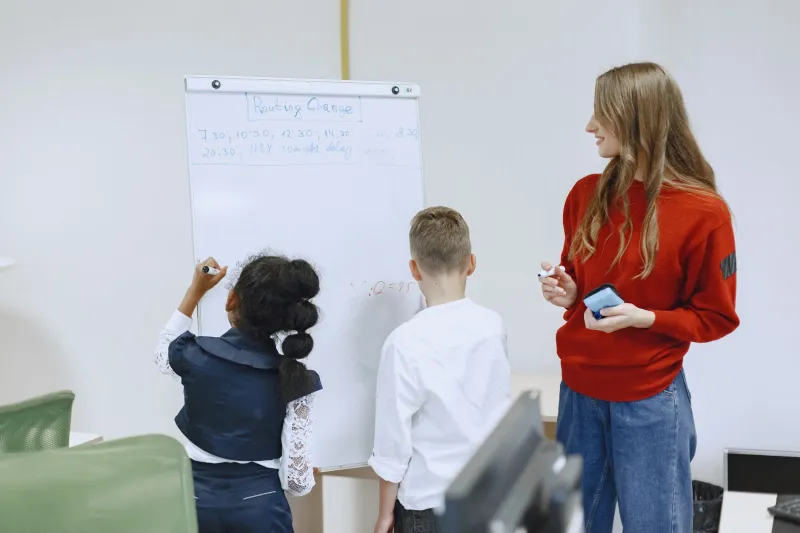
What the Board Reveals Before the Test Does: Using Student Work as a Formative Diagnostic

There is a particular kind of silence in a classroom that has nothing to do with noise. It is the silence of a student who does not raise a hand, who nods along without comprehension, who copies what is on the board without ever questioning whether it makes sense. That silence is nearly impossible to hear. But at the blackboard, it becomes visible.
Formative assessment is one of the most discussed concepts in American education, yet it is frequently reduced to exit tickets, clicker responses, or quick verbal checks. These tools have value. But none of them captures the layered, unfiltered record of thinking that a student leaves behind when they work at the board—writing, pausing, crossing out, hesitating, and sometimes stopping altogether. The board does not lie. And teachers who learn to read it carefully gain access to a diagnostic resource that no standardized instrument can replicate.
The Difference Between a Right Answer and a Confident Answer
When a student writes a correct answer on the board, the instinct is to move forward. The answer is there. The lesson can continue. But correctness and comprehension are not synonymous, and the board offers evidence of the distinction if a teacher knows where to look.
Consider the student who arrives at the right solution through a series of crossed-out steps, visible second-guessing, and a final answer that appears almost tentative in its placement on the board. That trail matters. It suggests a learner who is working at the edge of their understanding—someone who may not be able to reproduce that thinking independently, under pressure, or in a slightly different context. The correct answer is real, but the process reveals fragility.
Contrast that with the student whose work is linear, deliberate, and annotated with reasoning at each step. That student is not just answering a question; they are demonstrating a mental model. The board makes the difference between these two students legible in a way that a raised hand never could.
What Erasure Tells You That Writing Cannot
Among the most undervalued diagnostic signals in board-based instruction is the act of erasure. When a student erases something, they are communicating a moment of self-correction—and that moment is instructionally rich. The question is whether the teacher is positioned to see it.
Some erasures reflect healthy revision: a student catches an arithmetic error, adjusts a label, or reconsiders the structure of a written response. This is metacognition in motion, and it is worth acknowledging explicitly. Other erasures are more telling. When a student erases a substantial portion of their work and begins again from a different starting point, they may be signaling a foundational misconception—one that a surface-level correction will not resolve.
Teachers who circulate during board work, rather than monitoring from a fixed position at the front of the room, are far better equipped to observe these moments. Asking a student to walk through what they changed and why—rather than simply accepting the revised version—turns an erasure into a conversation and a conversation into assessment data.
The Diagnostic Power of Avoidance
Perhaps the most overlooked category of board behavior is what students do not write. Avoidance is not always obvious. It can look like a student who fills the board with peripheral information while leaving the central concept untouched. It can look like a student who copies a peer's structure without contributing original reasoning. It can look like a student who works slowly enough that the class moves on before they have to commit anything substantive to the board.
These patterns are not signs of laziness or disengagement in most cases. They are signs of uncertainty—and they are among the most honest signals a classroom can produce. A student who avoids writing a definition, a formula, or a thesis statement at the board is almost certainly uncertain about it. That uncertainty, identified early, is precisely what formative assessment is designed to address.
One practical approach is to assign specific, non-negotiable components to each student's board work. Rather than asking a student to "show their work" in an open-ended way, the teacher specifies: write the claim, then the evidence, then the connection. When a student leaves one of those components blank or vague, the gap is visible and actionable.
Building a Real-Time Feedback Loop
Formative assessment only functions if the information gathered changes what happens next. Observation without response is documentation, not instruction. The blackboard supports a feedback loop that is unusually immediate—teachers can respond to what they see in the same class period, often in the same lesson segment, without waiting for papers to be collected or data to be compiled.
When a teacher notices a recurring error across multiple students' board work—a misplaced apostrophe, an inverted fraction, a misidentified cause-and-effect relationship—that pattern signals a need for whole-class intervention. Rather than addressing the error privately with individual students, the teacher can pause the class, return to the board, and work through the misconception collectively. The board becomes both the site of the diagnostic and the site of the correction.
For individual gaps that do not appear across the whole class, a brief targeted exchange—conducted quietly while other students continue working—can redirect a student without disrupting the momentum of the lesson. This kind of precision is difficult to achieve through traditional assessment timelines. At the board, it is simply part of how the class runs.
Creating Conditions for Honest Board Work
None of this functions if students are performing at the board rather than thinking at it. When students perceive board work as a public evaluation—something to be judged rather than explored—they will default to the safest possible response: copying what they already know, mimicking a peer's approach, or producing work that is presentable rather than authentic.
Teachers can disrupt this dynamic through deliberate norm-setting. Framing board work explicitly as a thinking space, rather than a display space, changes what students believe is expected of them. Acknowledging and even celebrating visible revision—"I can see that you changed your approach here; let's talk about why"—signals that the process is the point, not just the product.
In classrooms where psychological safety around academic risk-taking has been cultivated consistently, board work becomes genuinely diagnostic. Students write what they actually think. They cross out what does not feel right. They ask questions in the margins. And teachers, in turn, receive information that no multiple-choice item could generate.
The Board as the Classroom's Most Honest Instrument
Formative assessment is, at its core, an act of listening. It requires teachers to gather information about where students are—not where a curriculum map says they should be—and to adjust accordingly. The blackboard, used with intention, is one of the most effective listening devices a classroom contains.
It captures thinking in progress. It preserves the evidence of uncertainty. It makes the gap between what a student knows and what they are expected to know visible, specific, and addressable. And it does all of this before the summative assessment, before the grade, and before the moment when the opportunity to intervene has already passed.
The board has always been a teaching tool. It is also, for those who learn to read it carefully, a diagnostic one.