Written in Plain Sight: What Student Board Work Tells You That Classroom Discussion Never Will

There is a particular kind of silence that settles over a classroom when a student walks to the front of the room and begins to write. It is not the silence of disengagement. It is the silence of a mind at work — and for the teacher watching, it is one of the most informative moments a lesson can produce.
Verbal participation, for all its value, carries a significant limitation: it is ephemeral. A student raises a hand, offers an answer, and the moment dissolves into the air. What remains is an impression, often filtered through the teacher's own expectations and the social dynamics of the room. Written board work, by contrast, leaves a record. It stays. It can be examined, questioned, and returned to. And in that permanence lies its diagnostic power.
The Gap Between Speaking and Knowing
Experienced educators have long recognized that a student who answers a question correctly in discussion does not necessarily understand the underlying concept. Verbal responses are frequently shaped by social cues — the phrasing of the question, the expressions of nearby peers, the tone the teacher uses when probing. Students learn, sometimes unconsciously, to navigate these cues and produce answers that satisfy without fully revealing what they know or do not know.
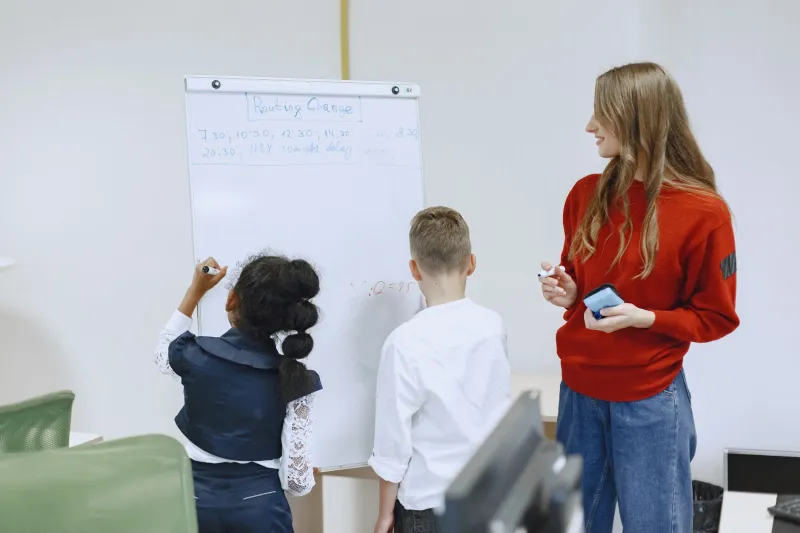
Board work disrupts this pattern. When a student is asked to diagram a process, solve a problem step by step, or represent a concept visually on a shared surface, the social scaffolding largely disappears. What remains is the thinking itself: unfiltered, incomplete in places, and often far more revealing than any verbal exchange.
Research in cognitive science supports this intuition. The act of externalizing thought — committing internal reasoning to a physical medium — requires a different kind of mental engagement than speaking. It slows the process down. It forces decisions about structure, sequence, and representation. In doing so, it exposes the architecture of a student's understanding in ways that spoken language rarely does.
The Emotional Safety of the Written Surface
There is also an affective dimension to board work that deserves careful attention. For many students, particularly those who are reticent in discussion, speaking aloud in a classroom carries a social risk that writing does not. The fear of mispronouncing a word, of losing one's train of thought mid-sentence, of being corrected in front of peers — these anxieties can suppress participation in ways that have nothing to do with comprehension.
The board offers a different kind of exposure. Writing is slower than speaking, which gives students time to organize their thoughts before committing them. Errors on a board can be erased, revised, and reconsidered — a physical enactment of the learning process itself. For students who struggle with verbal fluency but possess genuine intellectual capability, board work can function as an equalizer, providing a medium through which their thinking can finally be seen.
This is not to suggest that board work is without its own pressures. Standing at the front of a room is its own form of visibility. But teachers who establish consistent, low-stakes routines around student board use — rotating participation, framing errors as expected and valuable, modeling their own willingness to write imperfectly — can substantially reduce the anxiety that the surface initially provokes.
Reading the Board as a Diagnostic Tool
For teachers willing to look carefully, student-generated board work is a remarkably precise diagnostic instrument. Consider what a student's written work can reveal that a verbal answer typically cannot:
Procedural gaps become visible. When a student solves a multi-step problem at the board, every decision point is on display. A teacher can see exactly where the logic holds and precisely where it fractures — not just that an answer is wrong, but why.
Conceptual misconceptions surface clearly. A student who draws a diagram of the water cycle and places evaporation at the wrong stage is not guessing randomly. That diagram reflects a specific, coherent — if incorrect — mental model. Identifying that model is the first step toward addressing it.
Organizational thinking becomes legible. How a student structures written work — whether they move linearly or associatively, whether they use labels and arrows or dense prose — provides insight into their cognitive style and their current level of mastery. Organization is a form of understanding, and the board makes it readable.
Breakthrough moments leave a mark. When a student who has been struggling suddenly produces clear, accurate work at the board, that moment is documented. Teachers can reference it, celebrate it, and build from it in ways that a passing verbal exchange does not easily permit.
Practical Strategies for Structured Board Work
Integrating student board writing into regular classroom practice does not require dramatic restructuring. The following approaches are adaptable across grade levels and subject areas.
The silent board round. Assign three to five students to write simultaneously on different sections of the board in response to the same prompt. The silence requirement removes the social influence of hearing others' verbal responses first. After the writing period, the class examines and discusses what has appeared.
The error gallery. Rather than correcting student misconceptions privately, teachers can — with care and established classroom norms around psychological safety — use the board to display common errors anonymously and invite the class to diagnose them collectively. This transforms mistakes into shared learning objects rather than individual failures.
The concept map relay. One student begins a concept map on the board. Subsequent students add to it, draw connections, or revise existing elements. The resulting map is a collaborative artifact that reveals both individual and collective understanding across the class.
The before-and-after board. At the start of a unit, ask students to write or draw what they currently understand about a topic. Preserve a photograph of the board. At the unit's conclusion, return to the same prompt. The contrast between the two versions of student work is one of the most concrete measures of learning growth available to any classroom teacher.
What the Board Knows That You Don't
There is a quiet argument embedded in every classroom blackboard: that thinking, to be understood, must be made visible. Teachers have always known this about their own work — the board exists, after all, because writing something down makes it more real, more examinable, more teachable than simply saying it aloud.
The same logic applies to students. What a student writes on the board is not merely an answer. It is a window into the mind behind the answer — into the connections that have formed and those that have not, into the confidence that has been built and the uncertainty that persists. No hand raised in discussion, no matter how enthusiastically, offers quite the same view.
The teachers who understand this tend to look at their blackboards differently. Not as a surface for their own ideas, but as a shared space where the real work of learning — messy, partial, and utterly essential — can finally be seen by everyone in the room.