Marker in Hand: What Happens to Learning When Students Own the Board
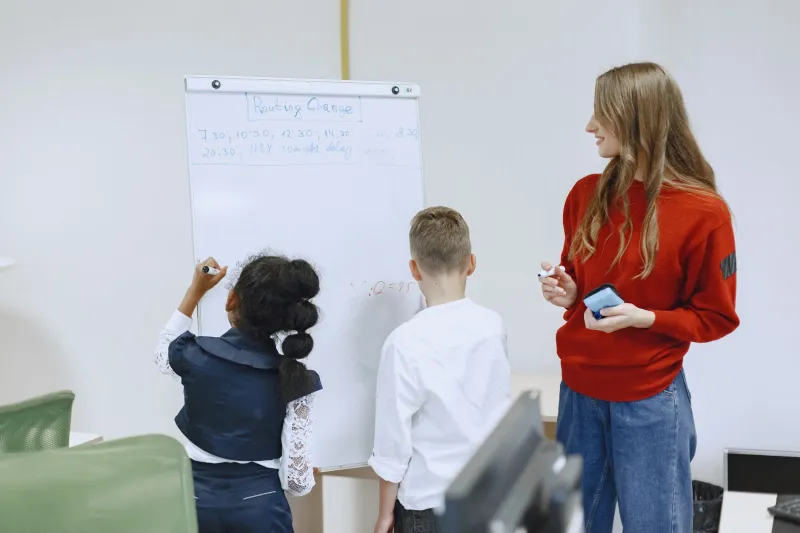
There is a moment familiar to many experienced teachers — a student approaches the board, marker in hand, and the room goes quiet in a way it never does when the teacher is writing. The stakes feel different. The attention sharpens. Something in the social contract of the classroom has shifted, and every student in the room feels it.
This is not a coincidence. It is pedagogy at work.
When teachers deliberately transfer board authority to students, they are not simply varying the routine. They are fundamentally reorganizing who holds knowledge in the room, who is accountable for communicating it, and how peers engage with one another around shared academic content. The implications for learning are significant — and frequently underestimated.
The Cognitive Difference Between Watching and Doing
Decades of research in cognitive psychology support a principle that classroom teachers have long observed intuitively: students who generate information retain it more effectively than students who receive it. This is sometimes called the generation effect, and it has direct implications for board-based instruction.
When a teacher writes a formula on the board, students process it as incoming information. Their task is to interpret and record. When a student writes that same formula — or, more powerfully, attempts to derive it from memory in front of their classmates — the cognitive demand increases substantially. The student must retrieve, organize, and externalize knowledge simultaneously, all under the watchful attention of a peer audience.
This pressure, when managed well, is productive. It forces a kind of mental rehearsal that passive note-taking does not require. Errors made publicly at the board become learning events — for the student writing and for those watching.
What Misconceptions Look Like When They're Visible
One of the most instructionally valuable outcomes of student-led board work is the exposure of misconceptions. In a traditional classroom, a student's misunderstanding often remains invisible until it surfaces on a quiz or test. By then, the opportunity to address it in real time — with the full class as witness and resource — has passed.
When students work at the board, misconceptions become visible immediately. A student who confuses correlation with causation, misremembers the steps of a historical event, or misapplies a grammatical rule will reveal that gap in the act of writing. This is not a failure of instruction — it is instruction made visible.
Savvy teachers treat these moments as diagnostic gold. Rather than correcting publicly in a way that might embarrass the student, skilled facilitators redirect by asking the class to respond: Does anyone see it differently? Can someone add to what's on the board? This transforms the error into a collaborative problem rather than an individual failing, and it models the intellectual norm that good thinking is iterative.
Building the Conditions for Student Confidence
Not every student will walk confidently to the front of the room. For many, particularly those who have experienced academic struggle or social anxiety, the board represents exposure — a public performance with no guarantee of success. Teachers who want to use student-led board work effectively must build the conditions for participation before they issue the invitation.
Several practical strategies support this:
Start with partners. Rather than sending one student to the board alone, invite two students to work together. The shared responsibility reduces individual pressure and often produces richer board content, since students negotiate their thinking as they write.
Establish a culture of drafting. Explicitly frame board work as a draft, not a final answer. Language matters here. When teachers say, Put up what you're thinking, not what you're certain about, they signal that the board is a thinking space, not a performance stage.
Rotate deliberately. Avoid patterns that consistently call on high-performing students. When students observe that board time is distributed equitably — that the teacher will eventually call on anyone — the anxiety of anticipation gives way to a kind of readiness. Students begin to prepare mentally because they understand that participation is expected of everyone.
Debrief the process, not just the product. After a student-led board session, take two or three minutes to discuss not only what was written but how the class arrived at it. This metacognitive reflection reinforces that the process of working through ideas publicly has value independent of whether the final answer was correct.
Managing Coherence When You're Not Holding the Marker
One legitimate concern among teachers who are new to student-led board work is the question of instructional coherence. When the teacher is no longer controlling what goes on the board, the lesson can drift. A student might take the discussion in an unproductive direction, introduce an error that goes unaddressed, or use the board in ways that confuse rather than clarify.
These risks are real, and they are manageable.
The key is what might be called structured release. Teachers who successfully facilitate student board work do not simply hand over the marker and step back. They establish a clear framework before the student begins: You're going to show us your approach to this problem. Start with what you know for certain, and flag anything you're unsure about. This framing keeps the student anchored and gives the teacher a clear entry point for facilitation.
Positioning also matters. When a student is at the board, the teacher should move toward the back of the room or to the side. This physical shift signals to the class that the student — not the teacher — is the primary communicator in that moment. It also allows the teacher to observe the room, noting which students are engaged, which are confused, and which might be ready to add to or challenge what's being written.
Peer Relationships and the Social Architecture of Learning
There is a dimension of student-led board work that goes beyond cognition: it changes how students see each other.
In classrooms where the teacher is always the knowledge authority, students have limited opportunities to recognize intellectual capacity in their peers. When a classmate explains a concept at the board — particularly a student who is not typically seen as academically prominent — it disrupts assumptions. Peers begin to understand that knowledge is distributed across the room, not concentrated at the front.
This shift has lasting effects on classroom culture. Students who have taught their peers, even briefly, report higher confidence in their own academic identity. Students who have learned from a peer often describe the experience as more memorable than receiving the same information from the teacher. There is something about the peer relationship — the shared language, the proximity of experience — that makes the transmission of ideas feel more accessible.
A Different Kind of Board
The blackboard — whether literal chalk, dry-erase marker, or digital equivalent — has long been understood as the teacher's domain. The space where instruction is delivered, where authority is exercised, where the official version of knowledge is recorded.
But classrooms that invite students to take up that space discover something instructive: the board does not diminish in authority when a student holds the marker. If anything, it gains a different kind of weight — one rooted not in hierarchy, but in shared intellectual investment.
The most powerful boards in any school building are not the ones that display a teacher's clearest thinking. They are the ones that show evidence of a room full of minds working together — complete with crossed-out attempts, arrows pointing to revisions, and questions written at the margins that nobody has answered yet.
That is not a board in disarray. That is a board doing exactly what it was always meant to do.