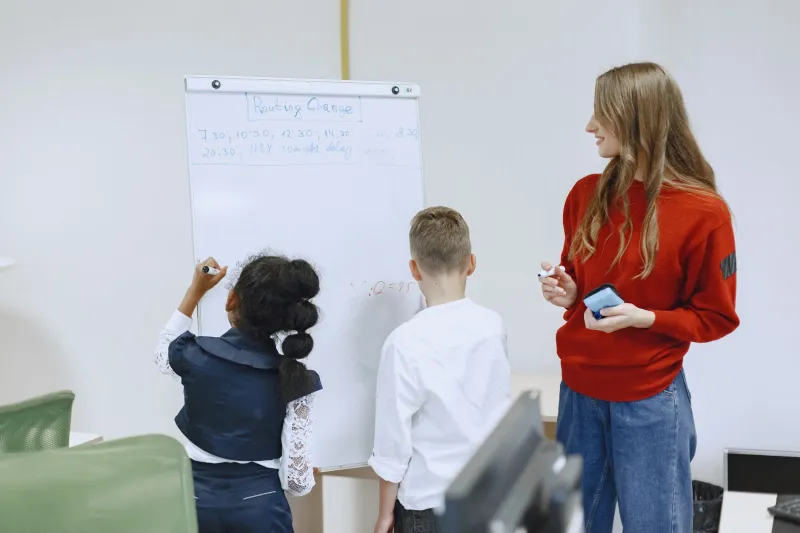
Writing Questions Worth Fighting Over: How to Turn Your Board Into a Genuine Thinking Provocation

The Difference Between a Question and an Invitation
There is a category of question that students answer because they have to, and there is another category they answer because they cannot help themselves. The gap between those two categories is not a matter of luck or student motivation. It is almost entirely a matter of craft.
When a teacher writes What is the main theme of the novel? on the board, students recognize the transaction immediately: produce an acceptable answer, receive acknowledgment, move on. The question has a destination, and everyone in the room knows it. But when a teacher writes The author gives the villain the most persuasive lines in the book — what does that decision cost the story? something different happens. Students lean forward. They disagree before they are asked to. The board has become a conversation partner rather than an instruction manual.
Designing that second kind of question is a learnable skill, and it begins with understanding why so many board prompts fail to generate genuine thought.
Why Most Board Questions Produce Compliance, Not Curiosity
The most common failure in board question design is what might be called answer visibility — the degree to which the correct response is already implied by the phrasing. Questions like How did the Civil War begin? or What formula do we use to find the area of a triangle? are not really questions at all. They are retrieval cues dressed in question marks. Students do not debate them because there is nothing to debate.
A second, subtler failure involves scope. Overly broad questions — What do you think about climate change? — produce not engagement but paralysis. Without a specific foothold, students default to the safest, most generic response available. Breadth, it turns out, is not the same as openness.
The most effective board questions occupy a precise middle ground: they are specific enough to give students traction, yet genuinely open enough that multiple defensible answers exist. That combination is what creates intellectual friction — the productive kind that makes a room feel alive.
The Architecture of a High-Engagement Board Prompt
Effective board questions tend to share several structural features, regardless of subject or grade level.
Embedded tension. The strongest prompts contain a built-in contradiction, an unexpected claim, or a premise that invites pushback. Rather than asking students to report information, they ask students to take a position in relation to something that is already in dispute. A high school history teacher might write: Reconstruction is often called a failure — but a failure for whom, and by whose definition? A middle school science teacher might try: If evolution is directionless, why do so many species seem perfectly designed for their environments? Neither question has a single correct answer. Both have several good ones.
Strategic specificity. Vague questions produce vague thinking. Specific questions — even when the answer remains open — give students a concrete problem to work with. Compare What makes a leader effective? with Lincoln kept cabinet members who openly disagreed with him. Was that a sign of strength or a failure of authority? The second question is narrower, but it generates far more genuine argument because students have something precise to push against.
Productive ambiguity. This is different from vagueness. A productively ambiguous question contains a term or premise that students must first interrogate before they can answer. When a teacher writes Is zero a number or an absence of one? on the board before a math lesson, students quickly discover they need to define their terms before they can argue their positions. That definitional work is itself a form of deep learning.
Visual Formatting as a Thinking Tool
How a question looks on the board matters nearly as much as what it says. Research on cognitive load suggests that visual organization directly influences how students process written information — and board questions are no exception.
Consider writing your central question in larger text, then adding a secondary line beneath it that complicates or qualifies it. A prompt structured as a two-part provocation — the main question followed by a challenge — signals to students that simple answers will not suffice. For example:
Should schools be required to teach financial literacy? Consider: most adults who learned it in school report they don't use it.
The secondary line does not answer the question; it destabilizes easy responses. Students who were prepared to say yes, obviously must now contend with evidence that unsettles their instinct.
Color coding, underlining key contested terms, or physically separating the question from any scaffolding you provide are all low-effort visual choices that communicate intellectual seriousness. A question that looks like it was written in thirty seconds will be answered in thirty seconds. A question that appears considered and deliberate tends to receive considered and deliberate responses.
Calibrating Questions Across Grade Levels and Subjects
The same principles apply across disciplines, but the execution shifts significantly depending on the age and prior knowledge of your students.
In elementary classrooms, productive tension often works best through surprise or reversal — presenting a counterintuitive scenario that contradicts what students assume they know. If plants need sunlight to survive, why do some plants live at the bottom of the ocean where there is no light? invites genuine wonder without requiring abstract reasoning.
In middle school, where social dynamics are powerful, questions that involve fairness, perspective-taking, or competing loyalties tend to generate the most authentic engagement. Students at this stage are deeply invested in questions about who is right and whether rules are just.
In high school and beyond, the most generative questions are often those that force students to choose between two legitimate goods or two legitimate interpretations. Framing questions as genuine dilemmas — Is it more intellectually honest to admit uncertainty or to commit to the best available explanation? — respects students' growing capacity for nuance and rewards complexity rather than punishing it.
From Prompt to Discussion: The Board's Role After the Question Is Posted
A well-designed board question does not end its work when students begin talking. It continues to function as a reference point throughout the discussion — a fixed text that students return to, reinterpret, and occasionally argue should be reworded. That last behavior, when it happens, is a significant indicator of genuine engagement. A student who says I think the question itself is misleading because... is not being difficult. They are doing exactly what the question was designed to provoke.
Leave the question on the board for the duration of the discussion. Resist the urge to annotate it with the "correct" answer as the conversation unfolds. The board's power in this context comes precisely from its neutrality — it posed the problem without resolving it, and that unresolved quality is what keeps students in motion.
When the discussion concludes, consider asking students to revise the original question based on what they now know. This closing move makes explicit what good questioning actually is: not a test of existing knowledge, but an instrument for building new understanding. That is a lesson worth writing on the board.