Ink Over Pixels: What Brain Science Tells Us About Writing by Hand in Front of Your Students
The pressure on American teachers to go fully digital is real and, in many respects, reasonable. Digital tools offer flexibility, accessibility, and the kind of visual polish that printed textbooks once monopolized. Interactive platforms can differentiate instruction, track progress, and connect students to resources far beyond any single classroom.
And yet something is lost when the last marker disappears from the tray and the projector becomes the only surface that matters. That something is not merely nostalgic — it is neurological. A growing body of research in cognitive science and educational psychology suggests that the act of composing thoughts by hand, in real time and in full view of students, engages learning systems in ways that consuming pre-made digital content does not.
For teachers deciding what to digitize and what to keep analog, that research deserves serious consideration.
What Happens in the Brain During Handwriting
The neuroscience of handwriting has advanced considerably in the past two decades, driven in part by the widespread adoption of keyboards and touchscreens and the corresponding questions about what might be lost in the transition.
Studies published in outlets including Psychological Science and the Journal of Educational Psychology have consistently found that handwriting engages a broader network of brain regions than typing. The motor cortex, responsible for the fine physical movements of writing, is activated in a way that pressing uniform keys is not. Critically, this motor activation appears to reinforce memory encoding — the physical act of forming a letter or word creates a sensorimotor trace that strengthens the brain's representation of that information.
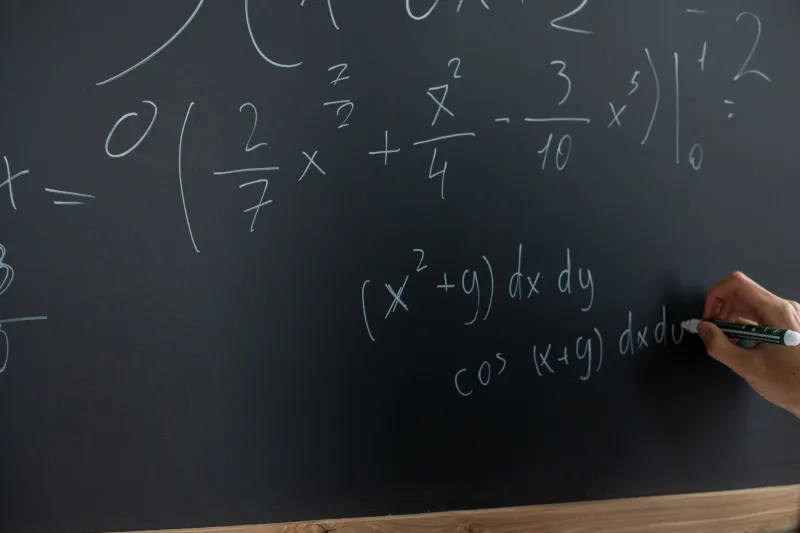
For students watching a teacher write, there is an additional mechanism at work: the mirror neuron system. When we observe someone performing a deliberate physical action — particularly a familiar one — our brains simulate that action internally. A student watching a teacher slowly compose a sentence or work through an equation on the board is not a passive observer. Their motor system is subtly engaged, tracking the movement and anticipating what comes next. This is a form of cognitive participation that watching a slide presentation cannot replicate.
The Difference Between Composed Thinking and Presented Content
There is a meaningful distinction between a teacher who is thinking on the board and a teacher who is presenting from it. Pre-made slides, however well designed, represent finished thought. They communicate conclusions. The board, used as a site of real-time composition, communicates the process by which conclusions are reached.
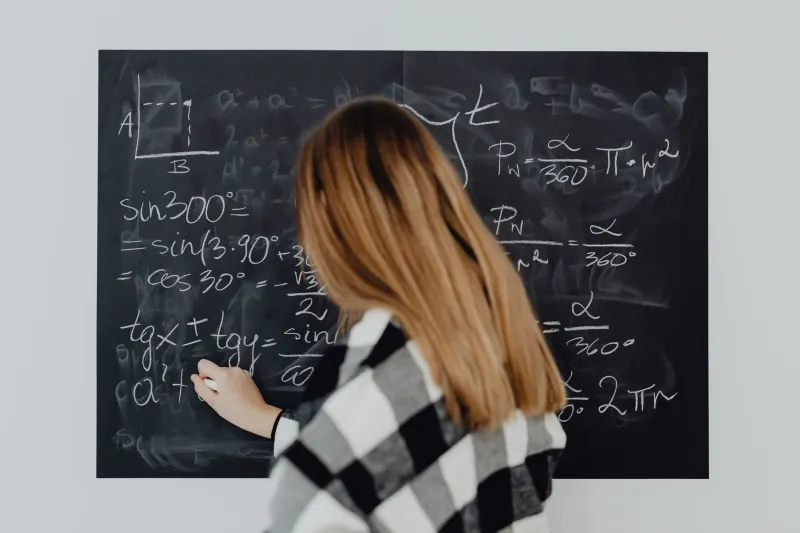
This distinction matters enormously for students who are learning not just content but the cognitive habits of a discipline. A mathematics student who watches a teacher work through a problem — pausing, reconsidering a step, crossing out an error, trying again — is watching mathematical thinking in action. A student who watches a completed solution appear on a slide is watching mathematical output. The first experience is instructive in a deeper sense than the second.
The same principle applies across subjects. A writing teacher who composes a thesis statement on the board in real time, revising it aloud as they write, is demonstrating the actual cognitive work of writing. A history teacher who builds a timeline by hand, debating with students where a particular event belongs, is modeling historical reasoning as a live practice rather than a finished product.
Cognitive scientists refer to this quality of instruction as making thinking visible. The board is uniquely suited to it because it is slow, physical, and irreversible in a way that digital tools are not. You cannot accidentally undo what you wrote on a blackboard. That constraint is, paradoxically, a pedagogical asset.
Emotional and Relational Dimensions of Analog Instruction
Beyond the neurological, there are emotional and relational dimensions to handwritten board instruction that deserve acknowledgment.
When a teacher writes on the board, they are physically present in the space in a way that a teacher clicking through slides is not. Their body faces the surface, moves along it, and returns to it. Students track that movement. The room organizes itself around the teacher's physical relationship to the board, and that organization creates a shared attentional focus that is more difficult to establish when instruction is delivered through a screen.
There is also a quality of vulnerability in handwriting that digital presentation forecloses. A teacher's handwriting is personal — it has idiosyncrasies, rhythms, and imperfections that no font possesses. When a teacher writes something incorrectly and corrects it, the evidence is visible. When they struggle to spell a word or reconsider a phrasing, students see it. These moments of visible imperfection are not weaknesses in the instructional relationship. Research on teacher credibility and student trust suggests that they are, in fact, strengthening. Students who see their teachers think imperfectly are more willing to think imperfectly themselves.
A Practical Framework for Analog-Digital Decisions
None of this argues for the wholesale rejection of digital tools. The question for working teachers is not whether to use technology but which tasks are better served by which medium.
A useful framework begins with a single question: Is this content I am presenting, or thinking I am doing?
Content that has been finalized — a rubric, a reading schedule, a set of instructions that will not change — is well suited to digital display or distribution. It benefits from the legibility, accessibility, and reproducibility that digital formats provide. There is no pedagogical reason to laboriously copy a syllabus onto a blackboard.
Thinking that is still in process — a problem being worked through, a concept being built from its components, an argument being constructed — belongs on the board. The act of writing it by hand, in front of students, in real time, is not a stylistic choice. It is the instruction.
A second consideration is duration. Information that students will need to reference repeatedly across a lesson or unit benefits from the physical persistence of the board. A slide that disappears when the teacher advances to the next screen is not a reference resource. A board that holds key terms, a developing concept map, or an unresolved central question across multiple class periods is.
Finally, consider what you want students to do with the information. If the goal is for students to receive and recall content, digital formats are efficient. If the goal is for students to observe, engage with, and internalize a mode of thinking, the board — and the hand that writes on it — is irreplaceable.
What Is at Stake
The drift toward fully digital instruction in American classrooms is not driven by evidence that it produces better learning. It is driven by convenience, by administrative pressure, and by the cultural assumption that newer tools are superior ones. The neuroscience does not support that assumption in the domain of instruction.
The blackboard is not a relic. It is a cognitive instrument — one whose effectiveness is grounded not in tradition but in the biology of how human brains learn from other human brains. Teachers who understand that distinction are better equipped to make intentional choices about when to reach for the marker and when to reach for the keyboard.
Those choices, made thoughtfully and consistently, add up to something significant: a classroom where thinking is not just displayed but witnessed, not just received but shared.