Smudge Marks and Second Drafts: What Physical Erasure Teaches That Digital Tools Cannot

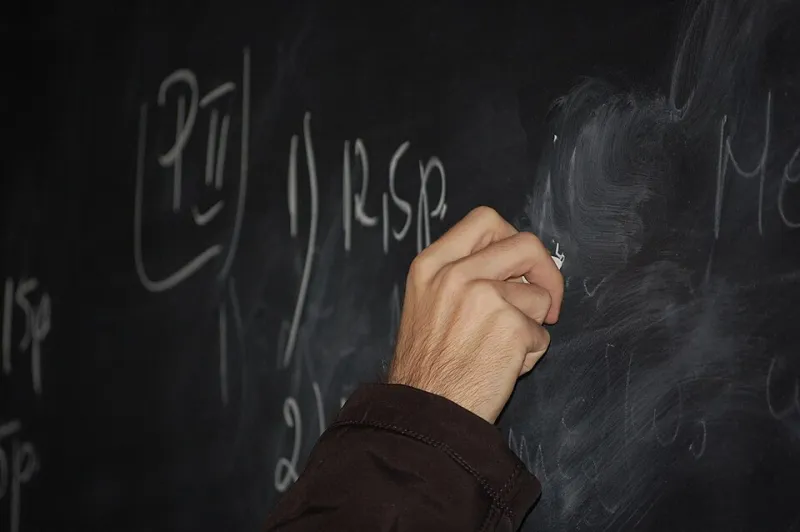
Photo: teacher erasing chalkboard with chalk dust visible classroom, via teacher.ac
There is a particular moment in any well-run classroom that tends to go unnoticed precisely because it looks like a mistake. A teacher writes an equation on the board, pauses, recognizes an error, and reaches for the eraser. The chalk dust settles. A faint outline of the wrong number remains. The teacher rewrites the correct figure beside it, perhaps narrating the correction aloud. Class continues.
To an outside observer, this might look like a minor interruption. To cognitive scientists and experienced educators, it is something considerably more significant: a live demonstration of how thinking actually works.
The Residue of Revision
Physical blackboards and whiteboards share a quality that no digital display can fully replicate — they retain evidence of what came before. Even after a thorough erasing, chalk leaves ghost impressions. Dry-erase markers smear. The board, in other words, has a memory.
This residue is not merely aesthetic. It functions as a visual timeline of thought. When students can see the faint outline of a crossed-out word or an overwritten number, they receive an implicit message: good thinking is not linear. The correction is not hidden. It is part of the record.
Digital tools operate on an entirely different philosophy. Interactive whiteboards, presentation software, and document cameras all offer some version of the undo function — a single keystroke or tap that eliminates an error as though it never existed. The screen returns to a pristine state. There is no smudge, no ghost, no trace.
This efficiency is, in many instructional contexts, a liability.
What Students Learn When They Watch You Struggle
Research on productive struggle — the idea that working through difficulty, rather than around it, produces deeper learning — has accumulated steadily over the past two decades. Studies from mathematics education in particular suggest that students who observe their teachers navigating confusion and correcting course develop more resilient problem-solving habits than those who are presented only with polished, error-free instruction.
The physical act of erasing supports this dynamic in ways that are easy to underestimate. When a teacher crosses out a wrong answer on the board and talks through why it was wrong, several things happen simultaneously:
- The error is acknowledged rather than erased from memory.
- The reasoning behind the correction becomes part of the lesson itself.
- Students who made the same mistake in their notes feel implicitly validated.
- The process of revision is modeled as a normal, even expected, component of intellectual work.
None of this requires the teacher to have made a genuine mistake, either. Deliberately writing an incorrect answer and then correcting it — a strategy sometimes called worked examples with errors — is a recognized instructional technique. On a physical board, the correction carries physical weight. The erasing takes effort. The rewriting takes time. Students watch the process unfold in real time, at human speed.
On a digital display, the same exercise can feel almost too clean. The wrong answer disappears before students have had a chance to sit with it.
The Classroom Culture of Correction
Beyond individual cognition, there is a classroom culture argument to be made here. The way a teacher handles visible mistakes on the board sends a signal to every student in the room about how mistakes are handled in general.
Consider what the digital undo button communicates, however unintentionally: errors are things to be eliminated quickly and completely. The cleaner the screen, the better the thinking. There is no room for the messy middle.
A physical board, by contrast, normalizes the messy middle. Students in classrooms where the board regularly shows crossed-out attempts, revised diagrams, and reconsidered vocabulary tend to develop a more forgiving relationship with their own errors. They learn, through repeated visual evidence, that revision is not a sign of failure — it is the mechanism of learning itself.
This is particularly consequential in subjects where students commonly develop what researchers call math anxiety or writing anxiety — fields where the fear of being wrong can become paralyzing. When the board itself shows a teacher crossing out and starting over, the implicit message is: this is what smart people do.
Practical Implications for Instructional Design
None of this is an argument against digital tools. Interactive displays and presentation software offer genuine instructional advantages, particularly for visual content, multimedia integration, and accessibility. The point is not to abandon the digital classroom but to be deliberate about when physical correction is the more powerful pedagogical choice.
Several practical principles follow from this analysis:
Resist the reflex to undo immediately. When you make an error on a digital display, consider pausing before you correct it. Name the mistake. Ask students to identify what went wrong. Then correct it — even if the correction is seamless, the verbal processing fills some of the gap that physical erasure would otherwise provide.
Reserve the board for high-stakes thinking. When a lesson involves complex problem-solving, argumentation, or revision-heavy writing, consider working on a physical surface rather than a digital one. The visible labor of correction reinforces the cognitive labor you are trying to model.
Narrate your corrections explicitly. Whether on a physical or digital surface, the act of talking through an error — I wrote this because I was thinking X, but that's wrong because Y — is at least as important as the visual record. The board is a prop; the narration is the lesson.
Let the smudge stay. When working on a physical board, there is no obligation to erase completely before moving forward. A partially erased diagram or a crossed-out sentence that remains faintly visible on the board is not a sign of poor preparation. It is a sign that thinking happened here.
A Different Kind of Clean
There is a version of instructional tidiness that serves students well: organized notes, clear diagrams, legible handwriting. And there is a version of tidiness that quietly undermines them — the kind that makes intellectual work look effortless, that hides the seams of reasoning, that trains students to expect thinking to arrive fully formed.
The blackboard, at its best, refuses that second kind of tidiness. It keeps the record honest. The smudge marks are not blemishes on the lesson. In many cases, they are the lesson.
The next time you reach for the eraser, consider what you are about to teach — not just by what you write next, but by what you choose to leave behind.