Less Is More: The Strategic Power of Leaving Your Board Intentionally Incomplete
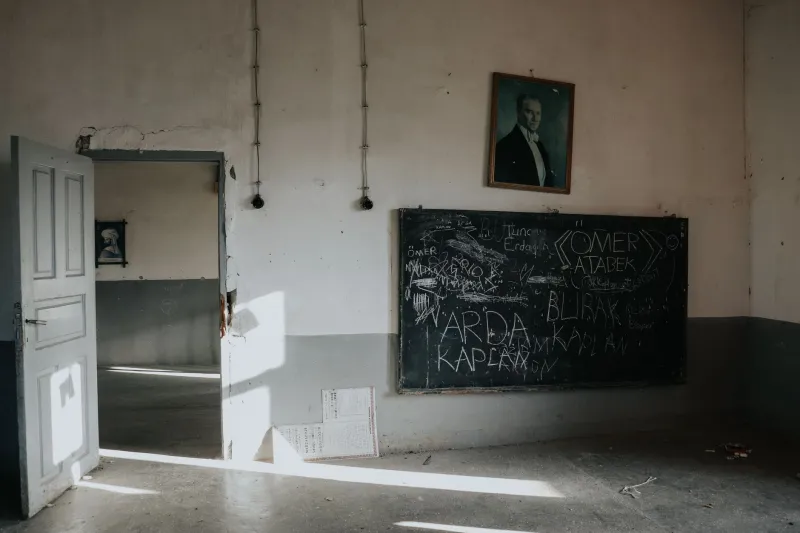
Walk into most American classrooms midway through a lesson, and you will likely find a board covered edge to edge. Vocabulary terms crowd the upper left corner. A half-finished diagram occupies the center. Homework reminders, learning objectives, and the day's agenda compete for attention along the margins. The board, in these rooms, is a monument to thoroughness — proof that the teacher has prepared, that content is being delivered, that learning is, presumably, happening.
But what if all that coverage is working against the very goals it is meant to serve?
The relationship between visual density and cognitive load is well-documented in educational psychology. When the brain is presented with too much competing information at once, it does not simply process everything in parallel. It struggles. It filters. And in that struggle, the most important content — the concept you most need students to grasp — is often the first casualty. The board, meant to anchor understanding, instead becomes a source of distraction.
There is another way. It requires resisting a deeply ingrained professional instinct, but the evidence for it is compelling: leave parts of the board blank, and leave them blank on purpose.
The Cognitive Case for Visual Breathing Room
Researchers who study attention and working memory consistently find that the human brain is not equipped to process unlimited streams of visual information simultaneously. John Sweller's Cognitive Load Theory, developed in the 1980s and refined extensively since, identifies what he calls "extraneous load" — the mental effort consumed not by thinking about content, but by simply navigating the environment in which that content is presented. A cluttered board generates extraneous load. It asks students to do interpretive work before they can do intellectual work.
Blank space, by contrast, serves a different cognitive function. It acts as a visual cue that signals hierarchy and priority. When a single equation sits alone in the center of a board, surrounded by nothing, students do not need to determine whether it is important. The space itself communicates that message. The eye is drawn, the brain follows, and attention — that most finite of classroom resources — is directed rather than scattered.
This is not a novel insight in design and communications. Graphic designers, architects, and typographers have understood the function of negative space for generations. What remains underappreciated is how directly those principles translate to the classroom environment, and specifically to the board that anchors instruction.
The Permission Problem
For many teachers, the resistance to leaving the board blank is less about pedagogy than about professional anxiety. In a school culture shaped by formal observations, administrative walkthroughs, and the pressure to demonstrate rigor, a partially empty board can feel like evidence of insufficient preparation. If the board is not full, the implicit worry goes, perhaps the lesson is not full either.
This perception deserves to be named and challenged directly. Intentional whitespace is not the same as an unplanned gap. A teacher who has deliberately reserved a section of the board for student-generated questions is not underprepared — they are creating the conditions for a specific kind of learning. A teacher who leaves a problem unsolved at the board until the class works through it together is not behind schedule — they are practicing one of the most effective forms of formative assessment available.
Building a shared professional language around strategic minimalism is part of how school communities can begin to distinguish between the two. Department heads and instructional coaches can play a meaningful role here by framing blank board space as a pedagogical decision worthy of discussion rather than a red flag.
Practical Frameworks for Strategic Whitespace
Implementing intentional whitespace does not require a wholesale reinvention of how you plan or deliver lessons. It begins with a few deliberate habits.
Reserve a section before class begins. Before students arrive, mentally — or physically — designate one portion of the board as off-limits until a specific moment in the lesson. This might be a corner reserved for questions that emerge organically during instruction, or a central space held open for the culminating problem of the day. The act of reserving the space in advance shifts it from an accident to a strategy.
Write less, pause more. Many teachers write continuously as they speak, filling the board in real time as a kind of visual transcript of their verbal delivery. Consider, instead, writing in deliberate bursts separated by pauses. Write the key term. Stop. Let it sit. Give students time to look at it, process it, and form a thought before the board fills with supporting details. The pause is not dead time — it is thinking time, and the blank space surrounding that lone key term is what makes the pause legible.
Use the blank space as an invitation. One of the most powerful uses of empty board space is explicitly social: invite students to fill it. A teacher who says, "I'm leaving this section open — what questions do you have that belong up here?" is doing something quite different from a teacher who asks for questions verbally. The physical act of writing a student's question on the board, in a space that was visibly held open for it, communicates that the question has weight and legitimacy. It changes the classroom dynamic in ways that verbal acknowledgment alone does not.
Treat the board as a timeline, not a canvas. Rather than thinking of the board as a surface to be filled by the end of class, think of it as a timeline that unfolds across the lesson. Early in class, it is largely empty. As the lesson progresses, key ideas accumulate. By the end, the board tells a coherent story — but one that was built incrementally, with space preserved at each stage for the thinking that was supposed to happen there.
What Students Learn from the Space Itself
There is a deeper argument for whitespace that goes beyond cognitive efficiency. When teachers model restraint — when they demonstrate that not everything needs to be said, written, and covered — they teach students something important about the nature of thinking itself.
Learning is not the same as transcription. Understanding does not arrive through exposure alone. It requires gaps, pauses, and unresolved questions. A board that is always full communicates, however unintentionally, that knowledge is something delivered rather than constructed. A board with deliberate empty spaces communicates the opposite: that there is room here for your thinking, your confusion, your contribution.
In an era when students carry devices capable of surfacing any fact within seconds, the classroom's comparative advantage is not information density. It is the quality of the thinking that happens in the room. Protecting space for that thinking — including the literal, physical space on the board where it can be made visible — is not a concession to minimalism. It is an act of instructional precision.
The most effective boards are not the fullest ones. They are the ones that know exactly what to leave out.