Productive Struggle on Display: What Happens in the Brain When Teachers Think Out Loud at the Board
There is a quiet assumption embedded in how many teachers approach the front of the room. The lesson is prepared. The steps are sequenced. The answer is already known. The teacher's job, in this model, is to transfer that finished knowledge cleanly and efficiently to the students sitting in rows before them. It is a reasonable instinct — and, according to a growing body of research in educational psychology, a deeply limiting one.
What students gain from watching a teacher perform a flawless demonstration is, at best, a model of a final product. What they gain from watching a teacher think — pause, reconsider, cross something out, and try again — is something far more durable: a model of a mind at work.
The distinction matters enormously, particularly as American educators grapple with persistent gaps in academic confidence, risk aversion in problem-solving, and what many teachers describe as a student reluctance to attempt anything they might get wrong.
The Neuroscience of Watching Someone Struggle
Mirror neurons, first identified in primate research and later associated with human observational learning, are activated not only when we perform an action but when we watch another person perform it. In educational contexts, this means that when a student observes a teacher wrestling with a problem — pausing at the board, reconsidering a step, catching an error — their own neural pathways associated with problem-solving are engaged in a way that passive observation of a completed process simply does not replicate.
Beyond mirror neuron activity, research in cognitive load theory suggests that when teachers present only polished solutions, students often cannot identify where the actual thinking occurred. The struggle — the moment of uncertainty that precedes a breakthrough — is invisible. Students are left with the impression that competent people simply know the answer, rather than understanding that competence is largely the capacity to navigate not knowing.
This perceptual gap has real consequences. Students who believe that intelligence means arriving at answers quickly and effortlessly are far more likely to interpret their own confusion as evidence of inadequacy. When the teacher's thinking is hidden, confusion feels like failure. When it is visible, confusion becomes recognizable as a normal stage in a process.
Growth Mindset Needs a Live Demonstration
Carol Dweck's foundational research on growth mindset — the belief that intelligence and ability are developable rather than fixed — has been widely adopted in American schools, often through posters, classroom mantras, and explicit lessons about the brain's capacity to grow. These efforts are well-intentioned, but they frequently remain abstract.
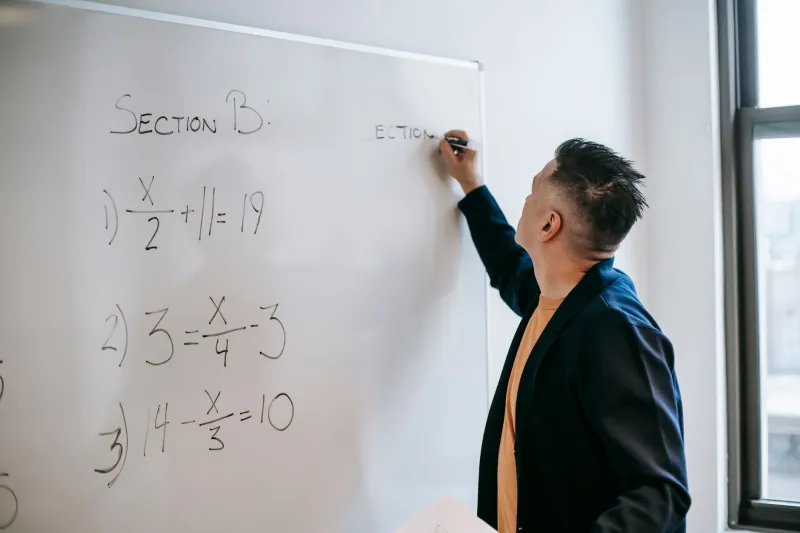
Telling a student that mistakes are opportunities for learning is categorically different from showing them what that looks like in practice. When a teacher stands at the blackboard, misapplies a formula, and then says aloud, "Wait — that doesn't look right. Let me go back and check my setup," they are not undermining their authority. They are providing a live, credible demonstration of exactly the cognitive behavior growth mindset theory promotes.
Students, particularly at the middle and high school levels, are extraordinarily attuned to authenticity. They can distinguish between a teacher who is performing humility and one who is genuinely working through uncertainty. The blackboard — with its unforgiving surface, its visible corrections, its smudged revisions — is one of the few instructional environments where that authenticity is structurally built in.
The Confidence Equation in Practice
Researchers studying classroom observation have identified a phenomenon sometimes called vicarious mastery — the confidence boost students experience not from their own success, but from watching someone they identify with succeed after struggle. Critically, this effect is strongest when the model is perceived as similar to the observer, and when the struggle is visible rather than glossed over.
This creates a specific and actionable opportunity for teachers. When you approach a problem at the board and allow students to watch you navigate genuine uncertainty — even if that uncertainty is somewhat performed for pedagogical effect — you are offering them a template. You are showing them that the path to a correct answer is not a straight line, and that competent thinkers do not panic when they encounter a detour.
Several practical approaches can help teachers leverage this dynamic more intentionally:
Narrate the uncertainty. Rather than silently correcting an error, say it out loud: "I went in this direction because I thought the equation was set up this way, but now I'm seeing that doesn't account for the variable on the left. Let me reconsider." The verbal narration transforms the correction from a mistake to be minimized into a thinking process to be studied.
Invite students into the confusion. When you reach a genuine point of uncertainty, resist the impulse to push through alone. Ask the class: "I'm not sure which approach to take here — what do you notice about this expression?" This positions productive struggle as a collaborative, rather than isolating, experience.
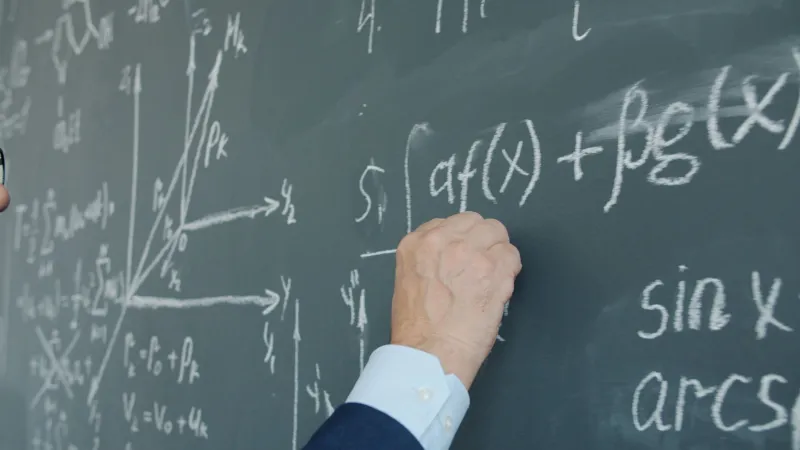
Leave the revision marks visible. One of the blackboard's most underappreciated features is that crossed-out work remains partially legible. Erasing cleanly removes evidence of the thinking process. Leaving visible corrections tells a more honest story about how problems actually get solved.
Return to errors deliberately. At the end of a lesson, briefly revisit a moment where you corrected course. Name what you noticed and what you did in response. This metacognitive debriefing helps students internalize the behavior, not just observe it.
What Research on Classroom Observation Tells Us
Studies examining teacher modeling in mathematics classrooms — a subject area with particularly high rates of student anxiety in the United States — consistently find that students who observe teachers engaging in visible self-correction demonstrate greater willingness to attempt challenging problems independently. They are also more likely to persist after an initial incorrect attempt, rather than stopping and waiting for guidance.
This effect appears to be mediated by a shift in students' implicit theories about what problem-solving looks like. When visible struggle is normalized by the teacher, students recalibrate their expectations for themselves. The internal monologue shifts from "I don't know the answer immediately, so I must not be good at this" to "I don't know the answer yet, which means I'm at the beginning of a process I've seen modeled."
That shift — subtle, almost imperceptible in a single lesson — compounds over time. Students who develop a more accurate mental model of what thinking looks like become more confident learners, not because they are told to be, but because they have seen, repeatedly, that uncertainty is survivable and productive.
The Board as a Mirror
There is something fitting about the blackboard's role in this conversation. It is, by its nature, a surface of revision. Nothing written on it is permanent. Chalk can be erased, corrected, reconsidered. In an era increasingly dominated by digital presentations that project polished slides and pre-rendered solutions, the blackboard retains a quality that no screen can fully replicate: it shows the hand that made the mark, and the hand that changed its mind.
For teachers willing to embrace that quality — to treat the board not as a stage for performance but as a workspace for thinking — the rewards extend well beyond any single lesson. They accumulate in students who approach difficult problems with steadiness rather than dread, who understand that confusion is not a destination but a waypoint, and who have watched, enough times, that even the person at the front of the room sometimes has to stop, look again, and find a better way forward.