Think Out Loud: Why Showing Your Mistakes at the Board Is the Most Powerful Teaching Move You're Not Making
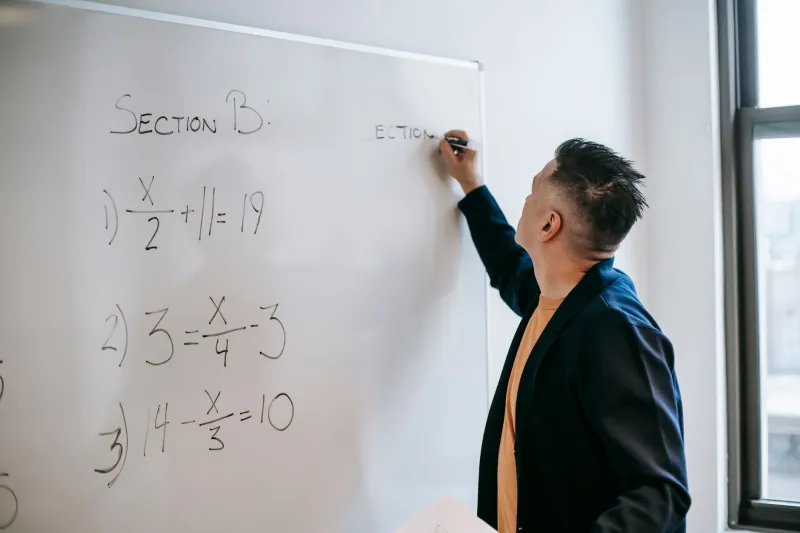
There is a quiet performance that happens in many American classrooms every day. A teacher walks to the board, picks up a marker, and executes a flawless explanation. The steps are clean. The logic is linear. The answer appears, almost inevitably, at the bottom of the board like the final line of a well-rehearsed monologue.
Students copy it down. Some understand it. Many do not. And a significant number quietly conclude that the gap between what the teacher just did and what they themselves are capable of doing is simply too wide to cross.
This is the unintended cost of performed perfection — and it is worth examining carefully.
The Permission Structure Hidden in a False Start
Cognitive psychologists have long understood that novice learners benefit enormously from observing expert thinking in process, not just expert thinking in product. When a teacher writes a problem on the board and immediately produces a correct solution, students see only the destination. They do not see the navigational decisions, the discarded routes, or the moments of uncertainty that preceded arrival.
Contrast that with a teacher who pauses mid-problem and says, aloud, "Wait — I went the wrong direction here. Let me back up." That single moment communicates something no textbook can: that confusion is not a sign of failure. It is a stage of thinking.
Researchers who study self-efficacy — a concept central to psychologist Albert Bandura's work — have found that students' beliefs about their own competence are shaped significantly by what they observe in others. When students watch a teacher struggle productively and recover, they receive what amounts to a biological permission slip. The internal message is not "my teacher makes mistakes," but rather "mistakes are part of how smart people work through hard things."
That distinction changes everything about how a student approaches the next difficult problem.
What "Visible Thinking" Actually Means in Practice
The phrase visible thinking has gained traction in educational circles, but it is often misunderstood as simply asking students to show their work. In its fuller sense, visible thinking refers to the deliberate externalization of cognitive processes — making the invisible mechanics of reasoning observable to others.
At the board, this looks like several specific behaviors:
Narrating uncertainty. Rather than projecting confidence through every step, a teacher might say, "I'm not immediately sure whether to factor this or use the quadratic formula — let me think through which approach makes more sense here." The narration slows the process down and invites students into the decision-making.
Leaving visible corrections. When a teacher erases an error completely before a student has registered it, the mistake disappears from the record. A more instructive approach is to cross through the incorrect step, leave it visible, and explicitly note why it was wrong. The correction becomes part of the lesson, not a blemish to be hidden.
Asking questions of yourself. Teachers who model internal dialogue — "Does this answer seem reasonable? Let me check it against what I know about the problem" — demonstrate metacognitive habits that students rarely see demonstrated explicitly. These habits are, arguably, more transferable than any specific content knowledge.
The Cultural Dimension: What Your Board Says About Failure
Classroom culture is shaped by a thousand small signals, and the board is one of the most visible surfaces on which those signals are broadcast. A board that only ever shows clean, completed thinking implicitly communicates that the journey to that thinking is either unimportant or shameful.
In contrast, a board that retains evidence of process — crossed-out attempts, revised diagrams, questions that were asked and then answered — tells a different story. It says that the classroom is a place where thinking happens, not merely a place where conclusions are delivered.
This matters with particular urgency for students who have internalized a fixed mindset about their own abilities. Research associated with Carol Dweck's work on growth mindset has consistently shown that students who believe intelligence is fixed are more likely to avoid challenge and interpret errors as evidence of inadequacy. A teacher who visibly struggles and recovers at the board provides a continuous, low-stakes counter-narrative to that belief.
For students from backgrounds where academic struggle has historically been stigmatized — or who are navigating the pressures of high-stakes testing environments common across many US school districts — this counter-narrative is not merely motivational. It is genuinely instructive about what learning requires.
Practical Strategies for Externalizing Your Reasoning
Adopting visible thinking as a regular practice does not require dramatic changes to how you teach. The following adjustments are modest in execution but substantial in effect.
Slow down the board deliberately. Most teachers write faster than students can process. Slowing your pace creates natural space for narration and allows students to track reasoning rather than simply transcribe results.
Introduce "I used to think / now I think" moments. At points of revision or correction, explicitly name the shift: "I started down this path because I assumed X, but now I can see that assumption was wrong." This models the kind of belief revision that characterizes genuine learning.
Invite students into your uncertainty. Rather than resolving every ambiguity yourself, pause and ask the class: "I have two ways I could approach this next step — which do you think makes more sense, and why?" This transforms visible thinking from a teacher monologue into a shared intellectual exercise.
Resist the impulse to clean up. At the end of a lesson, many teachers reflexively erase everything and present a tidy final version. Consider leaving the working board visible — with its crossed-out attempts and revised steps intact — as a record of the thinking that produced the conclusion.
The Teacher as Learner
There is a deeper principle operating beneath all of these strategies. When a teacher is willing to be visibly uncertain at the board, they are not diminishing their authority — they are redefining it. Authority in a learning environment need not rest on the performance of infallibility. It can rest, far more sustainably, on the demonstration of intellectual honesty and the modeling of genuine curiosity.
Students are remarkably perceptive about authenticity. They know when a teacher is performing mastery rather than engaging with ideas. And they take their cues about what learning looks like from that performance — or from its absence.
The board has always been a stage. The question is what kind of drama unfolds on it. A classroom where the teacher thinks out loud, makes recoverable errors, and treats the board as a working surface rather than a showcase is a classroom that quietly tells every student: your thinking belongs here too.
That message, delivered consistently over a school year, is among the most powerful things a teacher can offer.